A Gallery of  Unique Wedding Bands & Jewelry

Unique Wedding Rings and Commitment Bands

Home

Diamond Wedding Rings

Braided Wedding Bands

Gold Wedding Rings

Platinum Wedding Rings

White Gold Wedding Rings

Rose/Red Gold wedding Rings

Two-Tone Wedding Rings

Tri-Color Wedding Rings

Silver Wedding Rings

Cord of Three

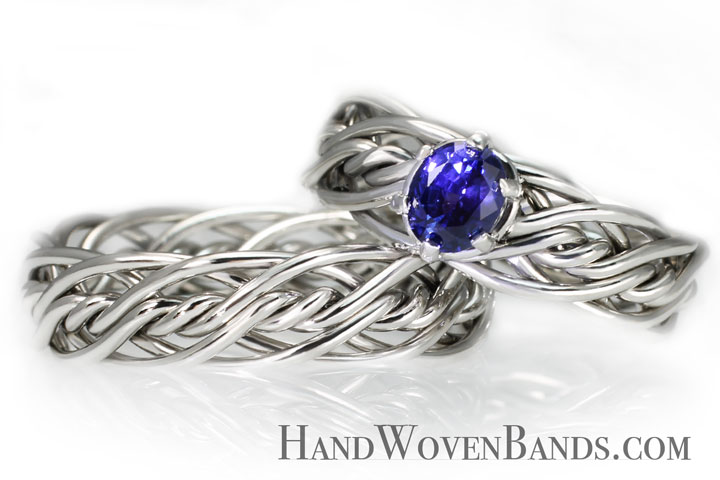
Braided Sapphire in Platinum

Todd Alan Studios

about the artist

about our rings

payment-options

FAQ

customer letters and photos

contact

guarantee & return policy

types of gold

 determining your ring size

ordering and shipping

   links

  site map


Our Guarantee  The wedding ring on your hand will be a constant reminder of your commitment to another person so choose a ring that is comfortable, durable as well as meaningful and beautiful.

Our fine line of wedding and commitment Bands are very,very comfortable to wear. And yes, our rings are as strong as they are beautiful!  Our gold and platinum braided wedding rings are designed to last a lifetime or more.

To fit you with the perfect ring, we offer free consultations.  We can help you to select the right style for your budget or custom design a unique wedding ring. 

Nervous about ordering over the internet?  Give us a call - we can answer all your questions and help make your ring purchase easy.

[MORE about our ordering process, guarantee and other policies]


Platinum Wedding Rings

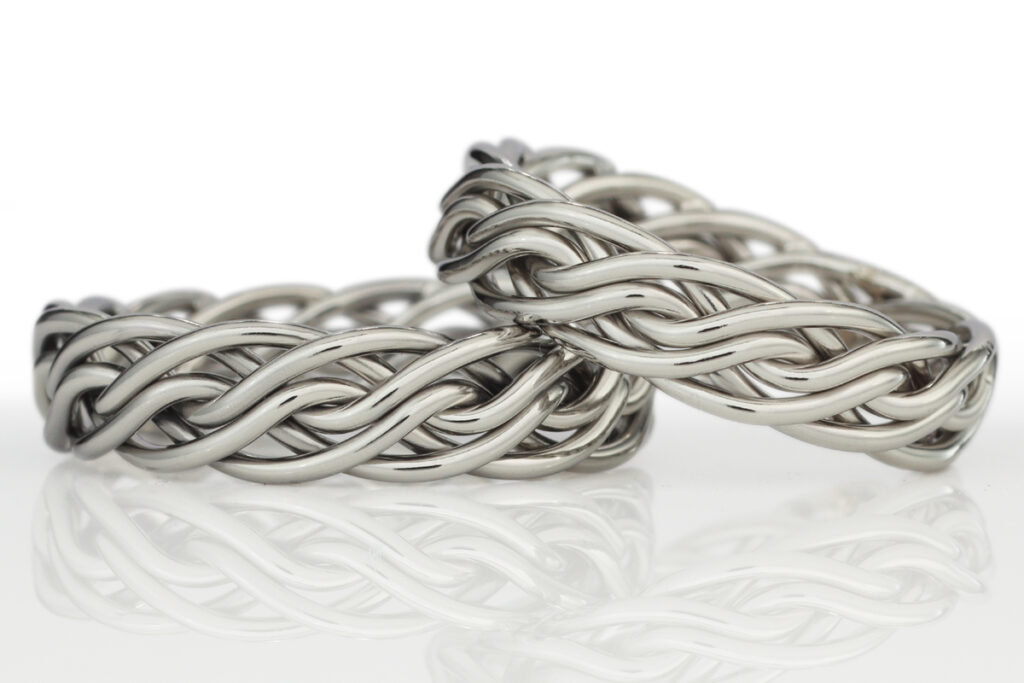
Platinum Braided Wedding Ring with Outer Bands

Welcome to our platinum wedding ring gallery. Here are the different braids we offer in platinum. Each braid is availiable in different thicknesses, click on any photo to find out more

The platinum we use is 95% platinum, 5% ruthenium.

Welcome to our gold wedding ring gallery. Here are the different braids we offer in platinum. Each braid is availiable in different thicknesses, click in any photo to find out more

Here we feature two galleries of braided rings, One features all of the different types of braids that Todd makes, handwoven in different thicknesses for every size hand. The second gallery features Todd's braids with added outer bands. These braids with added outer bands take on a completely different look and allow Todd to work with much finer strands while still making a strong ring sure to last. Click on any photo to find out more.

All of Todd's braided designs are original designs and protected by copyright.

 Todd's Braided Rings

Platinum Wedding Ring 518TP

Platinum Wedding Ring 618VP

Platinum Wedding Ring 818VP

Platinum Wedding Ring 418CP

Platinum Wedding Ring 518TP


Platinum Wedding Ring 818CP

Platinum Wedding Ring 818DP

 Platinum Wedding Ring 1018VP

Platinum Wedding Ring RM618CP

Platinum Wedding Ring 618CP

Platinum Wedding Ring RM818DP


Braided Rings With Outer Bands

OB620VP

OBRM520TP

OBRM620CP

OBRM820DP


Platinum Braided Wedding Ring with Outer Bands


As a pure metal, platinum is silvery-white, lustrous, ductile, and malleable. Platinum is more ductile than gold, silver and copper, thus being the most ductile of pure metals, but gold is still more malleable than platinum.  It does not oxidize at any temperature, although it is corroded by halogens, cyanides, sulfur, and caustic alkalis. Platinum is insoluble in hydrochloric and nitric acid, but dissolves in hot aqua regia to form chloroplatinic acid, H2PtCl6.


Platinum's resistance to wear and tarnish is well suited for making fine jewelry. The metal has an excellent resistance to corrosion and high temperature and has stable electrical properties. All of these characteristics have been used for industrial applications.

Platinum, rhodium, palladian -- three of the six separate elements in the platinum family -- are used for jewelry and decorative purposes. Platinum was in use for several centuries B.C., but a process to make it more malleable and workable was not discovered until 1804.

The color of the metal platinum is grayish white and resembles highly polished silver when finished. It is reasonably malleable and extremely ductile. The metal is softened with small percentages of silver or copper and is hardened when alloyed with iridium.

Like other metals, platinum work hardens and must be annealed to soften it to a malleable state. 

In addition to its use as a precious metal for jewelry, platinum is used for electric wires, contact points, dentistry, and photography. It is the only metal that will fuse with glass without breaking the glass, hence its former value for use in X-ray and other electronic tube manufacturing.


Platinum (play /?plæt?n?m/ or /?plæt?n?m/) is a chemical element with the chemical symbol Pt and an atomic number of 78.

Its name is derived from the Spanish term platina, which is literally translated into "little silver". It is a dense, malleable, ductile, precious, gray-white transition metal.

Even though it has six naturally occurring isotopes, platinum is one of the rarest elements in the Earth's crust and has an average abundance of approximately 5 ?g/kg. It is the least reactive metal. It occurs in some nickel and copper ores along with some native deposits, mostly in South Africa, which accounts for 80% of the world production.

As a member of the platinum group of elements, as well as of the group 10 of the periodic table of elements, platinum is generally non-reactive. It exhibits a remarkable resistance to corrosion, even at high temperatures, and as such is considered a noble metal. As a result, platinum is often found chemically uncombined as native platinum. Because it occurs naturally in the alluvial sands of various rivers, it was first used by pre-Columbian South American natives to produce artifacts. It was referenced in European writings as early as 16th century, but it was not until Antonio de Ulloa published a report on a new metal of Colombian origin in 1748 that it became investigated by scientists.

Platinum is used in catalytic converters, laboratory equipment, electrical contacts and electrodes, platinum resistance thermometers, dentistry equipment, and jewelry. Because only a few hundred tonnes are produced annually, it is a scarce material, and is highly valuable and is a major precious metal commodity. Being a heavy metal, it leads to health issues upon exposure to its salts, but due to its corrosion resistance, it is not as toxic as some metals. Its compounds, most notably cisplatin, are applied in chemotherapy against certain types of cancer

History

Platinum occurs naturally in the alluvial sands of various rivers, though there is little evidence of its use by ancient people. However, the metal was used by pre-Columbian Americans near modern-day Esmeraldas, Ecuador to produce artifacts of a white gold-platinum alloy. The first European reference to platinum appears in 1557 in the writings of the Italian humanist Julius Caesar Scaliger as a description of an unknown noble metal found between Darién and Mexico, "which no fire nor any Spanish artifice has yet been able to liquefy."

In 1741, Charles Wood, a British metallurgist, found various samples of Colombian platinum in Jamaica, which he sent to William Brownrigg for further investigation. Antonio de Ulloa, also credited with the discovery of platinum, returned to Spain from the French Geodesic Mission in 1746 after having been there for eight years. His historical account of the expedition included a description of platinum as being neither separable nor calcinable. Ulloa also anticipated the discovery of platinum mines. After publishing the report in 1748, Ulloa did not continue to investigate the new metal. In 1758, he was sent to superintend mercury mining operations in Huancavelica.

In 1750, after studying the platinum sent to him by Wood, Brownrigg presented a detailed account of the metal to the Royal Society, mentioning that he had seen no mention of it in any previous accounts of known minerals. Brownrigg also made note of platinum's extremely high melting point and refractoriness toward borax. Other chemists across Europe soon began studying platinum, including Andreas Sigismund Marggraf Torbern Bergman, Jöns Jakob Berzelius, William Lewis, and Pierre Macquer. In 1752, Henrik Scheffer published a detailed scientific description of the metal, which he referred to as "white gold", including an account of how he succeeded in fusing platinum ore with the aid of arsenic. Scheffer described platinum as being less pliable than gold, but with similar resistance to corrosion.

Carl von Sickingen researched platinum extensively in 1772. He succeeded in making malleable platinum by alloying it with gold, dissolving the alloy in hot aqua regia, precipitating the platinum with ammonium chloride, igniting the ammonium chloroplatinate, and hammering the resulting finely divided platinum to make it cohere. Franz Karl Achard made the first platinum crucible in 1784. He worked with the platinum by fusing it with arsenic, then later volatilizing the arsenic.

Since the other platinum family members were not discovered yet (platinum was the first in the list), Scheffer and Sickingen made the false assumption that due to its hardness – which is slightly more than for pure iron – platinum was a relatively non pliable material, even brittle at times, when in fact its ductility and malleability are close to that of gold. Their assumptions could not be avoided since the platinum they experimented with was highly contaminated with minute amounts of the platinum family elements such as Osmium and Iridium amongst others, which embrittled the platinum alloy. Alloying this impure platinum residue called "plyoxen" with gold was the only solution at the time to obtain a pliable compound, but nowadays, very pure platinum is available and extremely long wire can be drawn from pure platinum, very easily, due to its crystalline structure which is similar to that of many soft metals.

In 1786, Charles III of Spain provided a library and laboratory to Pierre-François Chabaneau to aid in his research of platinum. Chabaneau succeeded in removing various impurities from the ore, including gold, mercury, lead, copper, and iron. This led him to believe he was working with a single metal, but in truth the ore still contained the yet-undiscovered platinum group metals. This led to inconsistent results in his experiments. At times, the platinum seemed malleable, but when it was alloyed with iridium, it would be much more brittle. Sometimes the metal was entirely incombustible, but when alloyed with osmium, it would volatilize. After several months, Chabaneau succeeded in producing 23 kilograms of pure, malleable platinum by hammering and compressing the sponge form while white-hot. Chabeneau realized the infusibility of platinum would lend value to objects made of it, and so started a business with Joaquín Cabezas producing platinum ingots and utensils. This started what is known as the "platinum age" in Spain.

In 2007, Gerhard Ertl won the Nobel Prize in Chemistry for determining the detailed molecular mechanisms of the catalytic oxidation of carbon monoxide over platinum (catalytic converter).

Source: http://en.wikipedia.org/wiki/Platinum


Handwovenbands.com features a  selection of unique wedding bands, unique wedding rings, gold wedding bands and rings, white gold wedding bands, platinum wedding bands, comfort fit wedding bands and rings, wedding band sets, wedding bands for men, wedding bands for women, braided wedding bands, woven wedding bands, two tone wedding bands, 14k and 18k wedding bands, 18k and platinum wedding bands, engagement rings, diamond rings and other bridal jewelry.